Literature for teens is flooded with sexual content that would be intense at any age. As a result, books are being banned all over the country.
Is a book rating system the answer?
Opinion Piece By Young Adult Author Lorie Langdon

In the 2023–2024 school year alone, there were over 10,000 recorded instances of book bans across more than 4,000 unique titles, according to PEN America. Libraries and schools are getting more requests from parents to remove books with explicit sexual content that are targeted to teens and tweens. This raises a compelling question; are adult authors writing porn for minors?
Young Adult Literature is No Longer for Children
The young adult genre has grown by leaps and bounds since the days of Nancy Drew, Sweet Valley High, and The Outsiders.
Around 2006, the Twilight Series and Hunger Games ushered in a new genre of fiction. Young Adult books exploded onto the literary scene and earned their own section of bookstore and library shelves. Readers of all ages enjoyed these coming-of-age stories that were well-crafted, imaginative, and easier reads than many adult fiction options, yet contained more sophisticated plots and complex characterization than children’s books. Soon, fan-fiction online began to sexualize these young adult characters, spawning such mega best-sellers as Fifty Shades of Grey.
In the past decade, the books marketed to teens and tweens have crossed into adult territory, becoming increasingly mature in nature. Many of these novels contain step-by-step intimacy between heterosexual and homosexual couples, as well as extolling multiple partners at the same time.
At the time of writing this article the #4 New York Times best-selling young adult book, Bitten, contains descriptive depictions of a ‘threesome,’ erotic asphyxiation, and sexual violence. One of the biggest selling series of recent years, Haunting Adeline and Hunting Adeline, according to BooksRun.com includes detailed depictions of human trafficking, child abuse, stalking, and scenes of ‘romanticized’ rape that leads to the victim falling in love with her rapist, the man who physically and mentally abuses her. It is not enough for the author to say on Amazon, “Please visit my website for content warnings.”
Children are being exposed to these X-rated themes on bookstore shelves that are supposed to nurture their imaginations and protect their innocence. The damage has already been done by the time the parents realize what their children have read.
When the Problem Hits Too Close to Home
This October, my literary agent attended the Frankfurt Book Festival—one of the largest gatherings of publishing professionals in the world—and was told by every editor that they only want books with sexual content for their young adult imprints. These editors were from the U.S., as well as Europe.

When my first book, DOON, was released in 2013, I had a nine-year-old girl who devoured the series and attended my book events in multiple states. Many children with advanced reading levels are encouraged to read above their grade level. Which brings up the concern that has remained unaddressed in publishing; should adult authors who are pushing the envelope in order to get book sales be the ones to introduce sex to a nine-year-old?
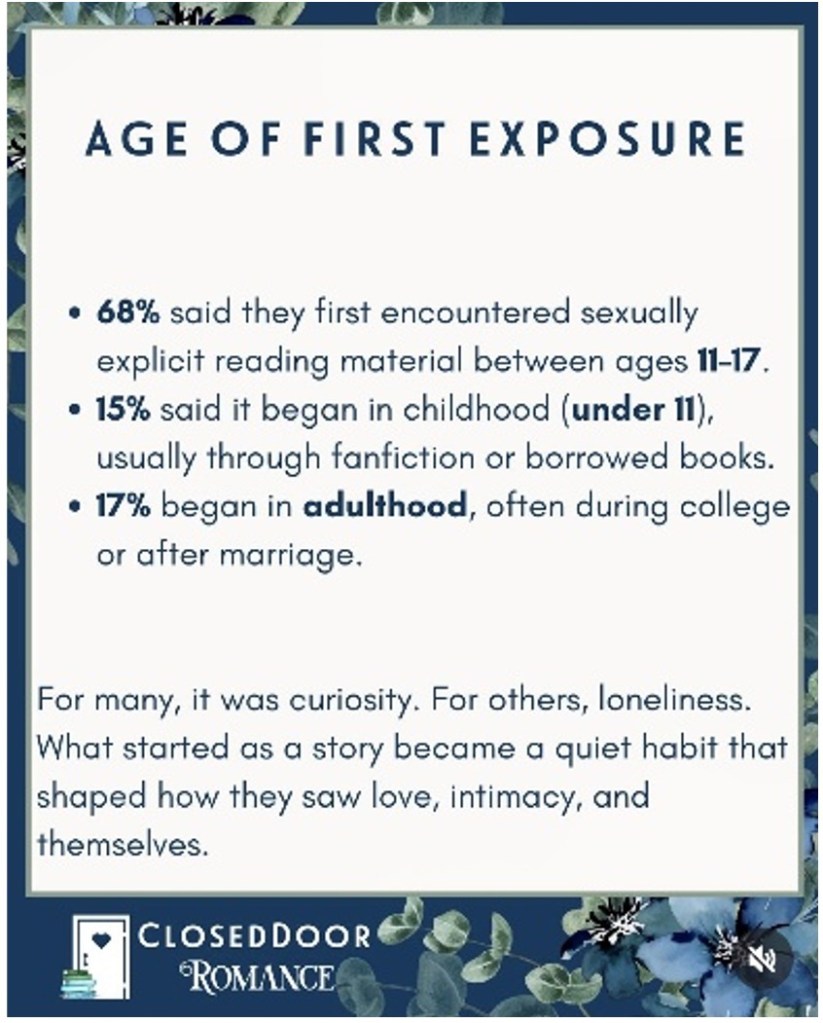
In 2025, Closed Door Romance conducted a survey of 56K romance readers and discovered that 68% first encountered sexually explicit reading material between the ages of 11-17, with 15% saying they were under 11 years of age. Many said this early exposure shaped how they saw love, intimacy, and themselves.
Due to this trend, many readers, teachers, and parents are turning to small, independent publishers like Quill & Flame who only publish ‘Books that Bring Light’ without sex on the page. Bookstores and libraries do not carry books from small publishers though, so this greatly decreases their distribution.
Moreover, at what point should publishers be held accountable for putting damaging material in our children’s hands? At the very least, if they cannot be made to stop exposing minors to X-rated adult content (a punishable offense in every other circle of our society), they can institute a rating system.
A Viable Solution
Media such as TV, movies, video games, and even music have content ratings or warnings which guide consumers and allow them to make informed decisions regarding their consumption. We have ‘parental controls’ on our tv streaming apps, smart phones, tablets, and Wi-fi systems. Why not books?
I, for one, would love a ratings sticker or a content warning page inside every book, not only for myself, but because adult books with fairytale tie-ins draw children in as well.
Industry Standards Need to Change
The ‘burning’ of objectionable books has happened for centuries. It’s time we do something different—a more sustainable solution that allows room for artistic freedom while protecting young readers and informing consumers. Let’s call for publishers to take responsibility for the content they print by instituting a standardized book rating system that is clearly displayed on every book cover.
We need to protect age-appropriate spaces for our children and teens to explore literature. It’s time for us to take a stand, and for publishing as a whole to do better.
NOTE: Lorie is planning a petition on a state level starting with libraries and parents. If you would like to join her or have expertise in this area, she would like to talk with you. Please email us to get in contact with her at thespinningpen@gmail.com
To hear Lorie Langdon talk more on this subject click here. She is open for questions via her DM’s on Instagram.
Stay tuned for our next article on Recommended Reading Lists for Teens, Young Adults and Families!
 The Spinning Pen